

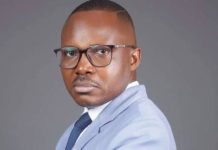













Olusegun Adenyi
Ever since the Presidential Foreign Investment Promotion Council (PFIPC) scandal involving Mr Adeniyi Adeyemi broke, there have been a focus on the annual budget of the federal government, especially given the N1.3 billion allocated to an agency that has been declared as fake. While Nigerians are being regaled with sordid tales from the House of Representatives ad hoc committee probe, many people have called for a reform of the budgeting process. I won’t hold my breath on that. I am almost certain that at the end of the day, nothing will be done because too many people in both the executive and legislature benefit from the current opaque budgeting regime. I made that clear in my column of 13 October 2022, titled, ‘When Budget Becomes Racket’. Below are a few excerpts from the piece.
*******************************************************
Last Friday, President Muhammadu Buhari presented the 2023 Appropriation bill to the National Assembly. It is his last and final one in office. The estimated expenditure for the 2023 fiscal year is N19.7 trillion with a proposed deficit of N10.78 trillion, representing 4.78 per cent of the estimated Gross Domestic Product (GDP). This is above the 3 percent per cent threshold set by the Fiscal Responsibility Act 2007. While I leave experts to continue their dissection, it may be important to look back before we leap forward. That way, we will understand that we don’t do budget in Nigeria. We simply share money.
In the 2022 budget, for instance, the federal government featured a line item for the office of ‘Retired National Assembly Clerks and Permanent Secretaries’ where over N581 million was allocated contrary to the Pension Reform Act 2004 (as amended in 2014). Ordinarily, these are/were career civil servants who for 30 to 35 years have been contributing to their pension account. Suddenly, they exit the scheme and begin to enjoy full life benefit at public expense. But who can blame them in a country where a governor who had served five months was deemed to have occupied office illegally by the Supreme Court but awarded an annual pension of a hundred million Naira?
Meanwhile, in the service wide provision of N1.93 trillion in the 2022 budget, ‘Monitoring of Integrated Payroll and Personnel Information System (IPPIS)’ has a provision of N1 billion. Despite that jumbo sum of money, these ‘monitors’ could still allow the Accountant General of the Federation to ‘misapply’ N108 billion without detection!
Looking at the capital component of the 2022 budget, several programmes are captured under capital projects. A good example is the ‘Annual National Local Government Summit’—an ‘ongoing’ capital project in the Ministry of Special Duties—although one can say that the sum of N10.029 million budgeted for it is small potato. The ‘National Veterinary Infrastructure and Abbattoirs/Slaughter Houses Development Programme’ is also captured as capital project in the sum of N310 million under the Federal Ministry of Agriculture and Rural Development.
In some cases, the budget provisions do not make any sense. For instance, in the Michael Imoudu Institute of Labour Studies under the Federal Ministry of Labour and Employment, the sums of N19 million, N14.25 million and N107.75 million were budgeted for the construction of office building, residential building and provision of electricity respectively. The question then is, what type of office can N19 million build or what kind of residential building can be executed with N14.25 million in today’s Nigeria? Such ridiculous provisions are replicated in virtually all the MDAs.
Under the Ministry of Works, several ongoing projects are allocated ridiculously low amounts. The construction and rehabilitation of Lokoja-Obajana-Kabba-Ilorin Road, described as ongoing, has a provision of N3.35 million. Yes, N3.35 million! Meanwhile, allocating equal funds to projects without regard to their scope, complexity and level of completion raises serious questions. The same amount of N208 million was allocated to both ongoing and new roads in Kano, Enugu, Kwara States with only N13.4 million for rehabilitation of Lafia-Obi-Awe-Tunga Road in Nasarawa State. All new projects in Akwa Ibom, Delta, Cross River, Kwara States also have equal provision of N50 million Naira each. What kind of new road can N50 million deliver?
I can go on and on to list numerous aspects of the ongoing 2022 budget that make little sense. But I believe my point is made. Ordinarily, a national budget should reflect the federal government’s fiscal and monetary policies that are targeted at economic development. That is not the case in Nigeria. Indeed, if the main objective of a budget is to reduce inequalities by mobilising and allocating resources for investment in the public sector, then what we operationalize annually in Nigeria is more of a racket than a budget!
ENDNOTE: I wrote the foregoing four years ago and it is just one of the more than a dozen columns I have done on what we call budget in Nigeria. As I concluded in one of them in November 2017, “given that the dire economic situation has pushed the nation in the direction of an aggressive tax drive, which is where we ought to have started in the first place, the authorities should also be aware that such monies are meant to fund critical infrastructure and social services, not pay for the indulgence of public servants who continue to live large at the expense of poor citizens.”
I am almost certain that by the time the 2027 budget is out, we will still be talking about the same issues. In Nigeria, we hardly learn from any experience!