
































Ime Akpan
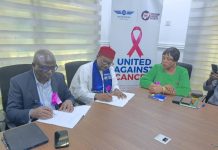
United Nigeria Airlines on Wednesday signed a memorandum of understanding with the Nigerian Cancer Society (NCS) to support cancer awareness, early detection and treatment, with passengers invited to make voluntary donations when booking tickets.
Speaking at the signing ceremony, the airline’s managing director Mr Osita Okonkwo said the partnership would use the carrier’s booking platform and flights to raise funds and spread information about cancer.
He said passengers booking tickets online will have the option to make voluntary donations ranging from N1, 000, N2, 000, N5, 000, or higher that go directly to a designated NCS account.
“You book a ticket; you have the option to make a voluntary contribution on our platform. You can do as little as 1,000; you can do as much as you want. All the monies raised, all the donations raised, will go directly to the society to an account designated by the society for this purpose,” he said.
Okonkwo stated that the carrier’s primary focus would be early detection, massive campaigns and information sharing, noting that cancer is not necessarily a death sentence if detected early.
He said the carrier would also make its flights available for awareness campaigns, including information in seat pockets for passengers who did not book through the website.
“Our position is that to fight cancer, you have to start from early detection. If you detect cancer early enough, you stand a very good chance of being treated and becoming cancer-free,” he said.
The managing director disclosed that he is a cancer survivor and that two of his sisters died of cancer.
He said speaking openly about the disease gives hope to others and encourages regular, simple and cost-effective checks.
“It is not a death sentence. The only way it is a death sentence is if you hide it, if you do nothing about it, if you fail to do the regular, simple, cost-effective investigations and tests that will help you,” Okonkwo said and urged Nigerians to rely on medical advice rather than superstition or claims that enemies are responsible for the disease.
Okonkwo said the airline’s cabin services department would coordinate the in-flight campaign to inform passengers about the initiative.
He described the partnership as an innovative, out-of-the-box approach and appealed to Nigerians to donate, saying small contributions would make a huge difference.
“United Nigeria, as you know, we are not just flying to fly; we are flying for a purpose,” he said. “This is a typical example of uniting to fight a deadly enemy, and together we shall overcome.”
He also called on the media to help spread the message, noting that information was as important as money in the fight against cancer.
In his response, the president Society, Prof. Abidemi Omonisi, expressed appreciation to the airline for the corporate social responsibility initiative to support cancer patients in Nigeria, aligning with the society’s mission.
As a non-profit organisation receiving no direct government funding, Omonisi said the NCS relies on fundraising to sustain its nationwide reach.
Despite the economic downturn and competing national priorities, he said he remained steadfast.
“We are committed to conquering cancer in Nigeria. We must avoid reaching a point where patients are left helpless. We need to prioritize primary screening and support existing cancer patients who have been abandoned,” he said.
He said the financial burden of cancer in Nigeria remains a massive hurdle, describing the health scourge as a “catastrophic disease,” noting that standard treatments like immunotherapy cost an average of N50 million.
Furthermore, he said the location of cancer centres in major cities like Lagos and Abuja forces rural patients into financial ruin.
“Many Nigerian patients spend all their savings, properties, and cars, becoming completely indigent just trying to afford transportation to hospitals,” he said.
Omonisi, therefore, advocated for a structured national screening framework, stating that while the Western countries utilise organised programmes with text reminders, Nigeria currently relies on “isolated, uncoordinated political campaigns” that often leave patients abandoned after diagnosis.
“Screening is the only escape route for developing countries. But screening must be tied directly to accessible support, diagnosis, and treatment resources,” he stressed, citing the success story of a primary breast cancer case discovered early, which, according to him, will mark 30 years of survival in 2027.