

































The president and chief executive officer of the Nigerian Cancer Society (NCS), Prof Abidemi Omonisi has highlighted the disparities in cancer care and treatment between Nigeria and Western countries.
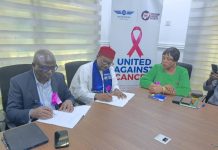
Speaking in Lagos during the signing of landmark partnership with United Airlines to support cancer patients, Omonisi pointed out that the genetic makeup of cancers in Nigeria differs significantly from those in white populations, rendering many Western-developed treatments less effective locally.
According to him, a patient in a Western country diagnosed with three cancers often has a better chance of survival than a Nigerian diagnosed with just one.
“Training in the UK showed patients with three different cancers surviving for 87 months due to drugs developed from specific scientific studies,” he said. “In contrast, because Nigeria lacks sufficient local studies, many drugs are researched and tested on white populations, resulting in minimal or no effect on Nigerian patients. Consequently, a Nigerian patient with just one cancer might not survive, whereas a Western patient with three or four cancers might.”
He said the Society “is now deeply involved in funding local research to tell the Nigerian story and generate scientific evidence that can lead to more effective, targeted treatments.”
Screening and high cost of care
Omonisi emphasised aggressive screening as the only escape route for developing countries, saying early detection makes treatment effective and allows people to live normal lives.
The anatomic pathologist, cancer epidemiologist and medical educator, noted that unlike Western countries with well-organised, national screening programs, Nigeria relies on “isolated, uncoordinated political campaigns where politicians screen people and leave them to their fate.”
He called for a structured national screening framework that is directly linked to accessible diagnosis and treatment.
He said this is particularly urgent given the catastrophic cost of cancer treatment, which can average N50 million for standard treatments like immunotherapy.
“Even wealthy individuals feel the financial strain,” Omonisi noted, adding that the burden forces many patients to sell their properties and cars, becoming completely indigent just trying to afford transportation to major cities where cancer centers are located.
“Many Nigerian patients spend all their savings, properties, and cars, becoming completely indigent just trying to afford transportation to hospitals,” he said. “Even with dedicated clinical oncologists, patients often face follow-up hurdles because they run out of money for transport or temporary lodging.”
As a non-governmental organisation that receives no direct government funding, he said the NCS relies on fundraising and partnerships like the one with United Airlines to sustain its nationwide reach.
Despite the challenges, Omonisi and his team remain steadfast in their mission.
“We are committed to a future where no Nigerian is left helpless in the fight against cancer,” he said.
He detailed the society’s nearly 60-year history and its ongoing mission to combat cancer through education, research, and advocacy.
The NCS chief noted that the new partnership with United Airlines is a crucial corporate social responsibility initiative that will provide tangible support to those battling the disease.
He said the NCS, which serves as an umbrella body for researchers, healthcare workers, survivors, and policymakers, was founded at a time when the federal government did not even acknowledge cancer as a reality in Nigeria.
“Sixty years ago, cancer was uncommon, and it was a group of researchers who started raising awareness based on cases they observed,” Professor Omonisi explained. “They faced a government that had no policy or data on the disease.”
Today, the society has grown into a nationwide organisation with a presence in all 36 states, the Federal Capital Territory, and international membership in 14 countries.
Its primary objective remains cancer education, aimed at dispelling harmful myths.
“We have seen cases where individuals believe breast cancer is a ‘boil’ until it becomes metastatic and untreatable, or that it can be caused by witchcraft,” Omonisi stated. “This is why we are active in marketplaces and schools, training youths to educate their peers and families.”