
















Ime Akpan
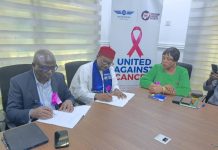
United Nigeria Airlines and the Nigerian Cancer Society (NCS) have signed a Memorandum of Understanding (MoU) to raise funds for cancer patients and support awareness, screening and treatment access, with Prof Abidemi Omonisi declaring that cancer does not respect age, wealth or social status.
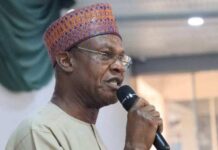
Speaking at the signing of a memorandum of understanding (MoU) between the airline and the NCS to raise funds for cancer victims held in Lagos recently, Omonisi said the partnership was not merely another talk about the biology of cancer but a practical move to flag off an initiative that will help reduce the burden of the disease in Nigeria.
“We are here for a purpose. We are not here to campaign or to talk about cancer, the biology and prevention. We are here to flag off this initiative,” he said.
Omonisi said cancer affects children and the elderly, the poor and the rich, and has touched families, churches, mosques, communities and the country at large. He noted that Nigeria has lost past presidents and politicians to cancer, while others are living with the disease, stressing that it can affect “a day-old baby to an elder.”
He described the financial burden of cancer as a form of “financial toxicity,” noting that in some cases an entire community, church or group of friends has had to pull resources together to save a patient’s life.
While acknowledging gaps in infrastructure and diagnosis, Omonisi said Nigeria has made progress in policy. He said the NCS, which is almost 60 years old, has contributed to every major cancer policy in the country and engaged the National Assembly on legislation. He noted that Nigeria now has a cancer control plan covering 2026 to 2030, adding that fewer than five African countries have an up-to-date plan.
However, he said implementation and funding remain major challenges. He also raised concerns over access to chemotherapy drugs, recalling that some pharmaceutical companies, including Pfizer and Johnson & Johnson, exited the country, making access more difficult and expensive. He called for subsidies and duty waivers where possible.
Omonisi stressed that cancer treatment requires specially trained experts, not every doctor or nurse, and urged patients to seek care at centres of excellence with oncologists. He advised Nigerians to embrace early screening, noting that genetic testing is limited in the country and many cases are detected late.
On prevention, he said the exact cause of most cancers remains unknown, but predisposing factors include genetic, environmental and multifactorial causes. He mentioned smoking, pollution, diet and family history, and said exclusive breastfeeding for at least six months has a protective effect against breast cancer. He also encouraged breast self-examination and partner involvement in detecting lumps early.
He said the partnership with United Nigeria Airlines would go a long way in addressing the funding gap, adding that the NCS is transparent about funds because “every penny must be accounted for.”
Airline pledges accountability in cancer fundraising partnership
Meanwhile, the carrier assured donors that every kobo contributed to its cancer fundraising partnership with the NCS will be fully accounted for, with a dedicated online account, no cash transactions and monthly reconciliation of funds and programmes.
The managing director of the airline, Mr Osita Okonkwo, who stated this at the signing of the MoU, said the carrier had set up a system to collect free-will donations online, including an appeal on its website when passengers buy tickets, adding that donations would go into a dedicated account.
“There will be a dedicated account. Everything is online; there is no cash transaction. If you open our website and you’re buying a ticket, there is an appeal for you to make a donation — free-will donation, not by force. Once that money is collected, it goes into that dedicated account,” he said.
He explained that the second option is an in-flight collection, where an appeal will be made inside the aircraft and passengers can make free-will donations. He added that if the outcome is positive, as expected, the airline will provide monthly updates, reconcile accounts and programmes, and carry out all administrative requirements.
Okonkwo said the airline researched the NCS before deciding to work with it, stressing that the society is not a “fly-by-night” organisation but one with competence, structure, expertise and the capacity to administer funds.
“What it may not have in abundance is money. That is now what we have come to bridge, and we are praying that it goes as planned or even exceeds our expectations,” he said.
He assured donors and prospective donors of accountability, saying the airline will update the public from time to time on what has been raised and what is being done with the funds.
“With United Nigeria and the Nigerian Cancer Society, every cent that is donated will be fully accounted for,” he said.
Asked how long the partnership would last, Okonkwo replied: “As long as it takes to defeat cancer.”
He said the airline’s cabin services manager and cabin crew, who he described as having “very nice voices,” will appeal to passengers. He noted that a passenger might be moved to write a cheque and hand it to a crew member, adding that the airline hopes to see such generous donations.
Okonkwo said the airline has over one million passengers and a database it will use to inform customers about the campaign.
He expressed confidence that Nigerians are generous, adding that the fight against cancer is not about government but about people helping themselves and their communities.